
Freeborn Transfers to Minnesota DOC
No Minnesota state prison was identified inside Freeborn County. The Minnesota Department of Corrections facilities listed here represent the statewide prison and corrections system, not a second county jail. A person sentenced or committed from Freeborn County can still enter DOC custody at a facility elsewhere in Minnesota. The county’s dated in-custody list is no longer the right lookup after that transfer.
A transfer from the Freeborn County Adult Detention Center to Minnesota DOC is not community release. It means the person left county custody and entered state correctional custody. Request the sheriff’s transfer date, time, legal basis, and receiving agency under Minn. Stat. §13.82, subd. 2(h). Then use the court commitment or sentencing order to connect the Freeborn case with the DOC record.
| Event | Correct record | What it establishes |
|---|---|---|
| County-to-DOC transfer | Sheriff transfer entry | When county custody ended and which agency received the person |
| DOC incarceration | DOC Public Viewer | Current state status and facility context |
| Prison release | DOC status and release-type date | Exit from prison, often with DOC supervision continuing |
| Sentence expiration or discharge | DOC record or records request | The corrections endpoint stated by DOC |
New commitments can take several business days to appear in the Public Viewer. During that gap, the sheriff transfer entry and court commitment are the best bridge. Keep the event labeled “transferred” until DOC reports the next status. A missing county roster name alone does not establish either transfer or release.
Minnesota DOC Offender Release Search
The Minnesota DOC Public Viewer covers adults committed to the Commissioner of Corrections who remain under DOC jurisdiction. That includes people in prison and people released from prison who are still under supervision. It does not serve as a Freeborn County booking archive. A county-only jail episode may never appear there.
- Open the Public Viewer and review its stated scope and limits.
- Search by the person’s name or MNDOC Offender ID. The six-digit DOC identifier is the stronger match.
- Compare the full name, birth data, case information, and sentence details. Do not rely on a common name alone.
- Open the detail record and record the exact status, facility or supervision unit, case information, and every date label.
- Match the DOC court file number to the Freeborn County case when the state episode began there.
- Save the access date because custody, supervision, and calculated dates can change.
The successful manifest image comes from the official Minnesota DOC offender search.
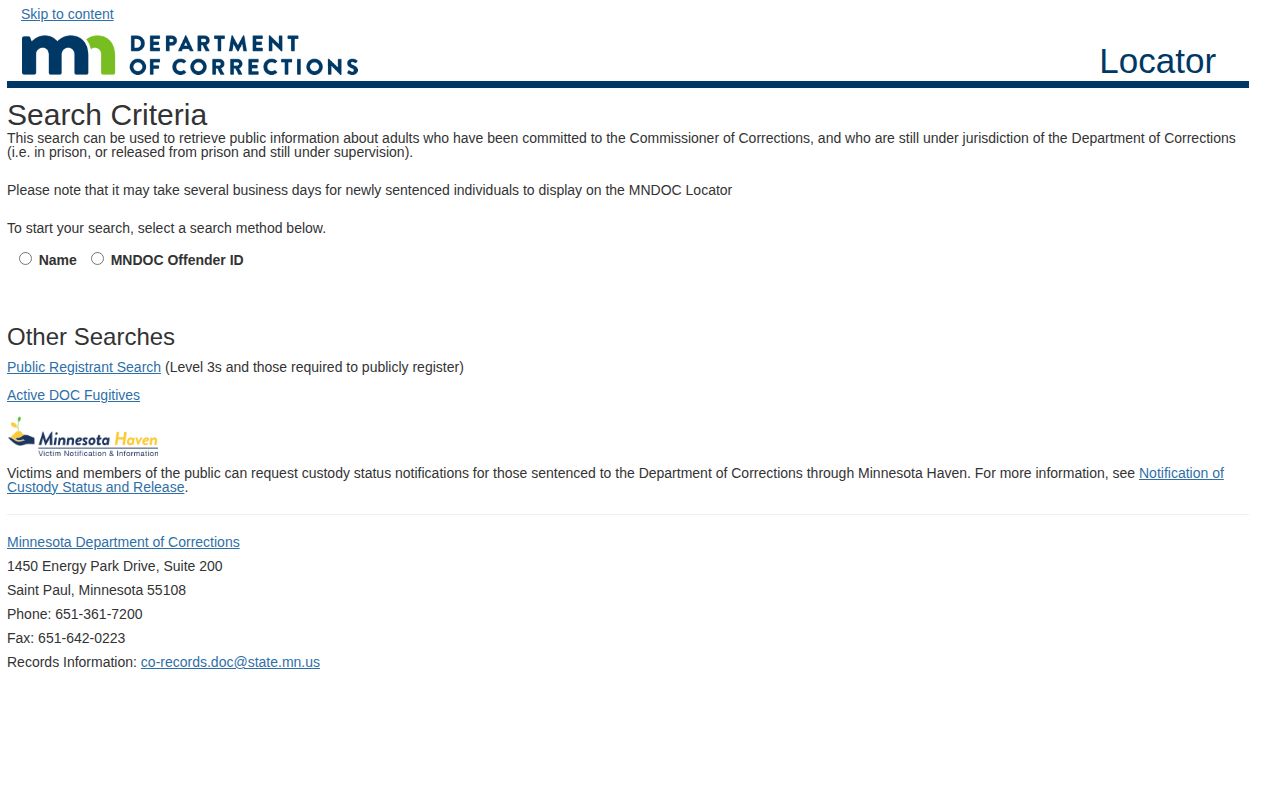
The viewer separates present status, facility or supervision context, sentence data, and controlling dates, which prevents an anticipated event from being reported as completed.
Minnesota DOC Release Record Fields
An incarcerated detail can display current status and facility, sentence date, Anticipated Release Date, expiration date, highest-ranked offense, court file number, and a caseworker contact. These fields answer different questions. The anticipated date concerns an expected move from incarceration under the current calculation. Expiration concerns the later sentence or jurisdiction endpoint shown by DOC.
| Public Viewer field | How to read it |
|---|---|
| Current Status | DOC’s present public statement of incarceration or a named supervision status |
| Current facility or unit | Prison location or community supervision context |
| Anticipated Release Date | Expected prison exit under the current calculation, not confirmation |
| Under [release type] as of [date] | Completed prison exit into the precise supervision form shown |
| Expiration date | The sentence or jurisdiction endpoint displayed by DOC |
| Court file number | The link back to the sentencing and commitment case |
Preserve the wording. CIP Program Release, supervised release, parole, and other labels are not interchangeable. A person can be outside a prison facility for years while remaining under DOC supervision. A later end of active reporting through compliance credit also may differ from legal sentence expiration and final discharge.
A fully discharged person may return no Public Viewer result after DOC jurisdiction ends. That absence does not prove the person was never imprisoned or supervised. Historical proof then belongs in DOC records and the court file. The same limit applies to a county detainee who was never committed to state corrections.
Note: Report every DOC date with its visible label and access date instead of replacing it with a broad “released” description.
Minnesota DOC Anticipated Release Dates
Minnesota is not a generic “serve 85 percent” state. For ordinary modern executed felony sentences, Minn. Stat. §§244.01 and 244.101 describe a two-thirds imprisonment component and a one-third supervised-release component. The old one-day-for-two-days good-time rule applies to crimes committed before August 1, 1993, not ordinary modern offenses.
The Minnesota Rehabilitation and Reinvestment Act adds earned incentive release credit for eligible participants with an individualized rehabilitation plan. Under Minn. Stat. §§244.41 through 244.45, earned incentive release credit can reach 17 percent of the executed sentence and cannot reduce confinement below one-half of that sentence. Credit may be revoked for rule violations or criminal conduct. It does not shorten the total legal sentence or lengthen supervised release.
Other factors can move the Anticipated Release Date. They include disciplinary confinement, an earned-credit award or revocation, a sentence correction, consecutive sentences, a special program, Board action, and a statutory calendar rule. Under §244.05, a modern scheduled supervised-release date that falls on Friday, Saturday, Sunday, or a holiday moves to the next day outside those categories. Older offenses use a different rule.
| Displayed date or event | Why it can differ |
|---|---|
| Anticipated Release Date | Current sentence calculation, credits, discipline, programs, and court action |
| Supervision start | Actual prison exit and the release type recorded by DOC |
| Expiration | The legal sentence endpoint rather than the prison-door date |
| Final discharge | The DOC or Board action ending the applicable corrections authority |
If an anticipated date passes while status remains incarcerated, do not declare release. Refresh the Public Viewer, contact the listed caseworker or DOC Records, and check for recalculation or other authority. Current Status is DOC’s present public statement. The anticipated field is not a promise.
Minnesota DOC Supervised Release Status
An “Under Supervision” detail is affirmative evidence that prison confinement ended while DOC jurisdiction continues. It can state “Under [release type] as of [date],” identify the current district or unit, show sentence and expiration dates, and link to an agent or office. Record the MNDOC Offender ID, the exact release-type phrase, and the as-of date before contacting the linked office.
The DOC Community Services Directory can be searched by county, district, principal office, and staff name. It is an office directory, not a public person-by-person supervision list. Freeborn County probation is also distinct. A person given local probation may be outside jail without ever entering DOC prison custody, so the court order and local probation office are the right sources for that population.
- Supervised release
- Community placement after the prison portion while DOC control remains.
- Probation
- A court-ordered community sentence that may be administered locally without prison.
- Expiration
- The sentence or jurisdiction endpoint shown in the corrections record.
- Discharge
- The formal end of the applicable correctional authority.
- Absconder
- A person DOC says left supervision without authorization and remains wanted.
DOC also publishes an active-fugitive view. A “Wanted Fugitive” or absconder listing asserts continuing DOC jurisdiction and a request for return. It is not discharge or successful completion of supervision. For prison custody and release notification, Minnesota DOC uses HAVEN. Minnesota VINE is the county-jail notification channel and does not provide Minnesota prison notifications.
Minnesota DOC Release Records Contact
Use DOC Records when the Public Viewer no longer covers the person, when a historical discharge is needed, or when the visible record does not resolve the exact status. Ask for an existing release type and date, supervision start, expiration, final-discharge record or certificate, or a Board decision. Include the MNDOC Offender ID and court file number when available.
1450 Energy Park Drive, Suite 200
Saint Paul, MN 55108
Central office: 651-361-7200
Records Management: 651-361-7330
Fax: 612-473-5006
CO-Records.DOC@state.mn.us
The DOC Data Practices office is the formal records-request route. DOC need not create, collect, or rearrange data into a custom format. A narrow request for the maintained record is more useful than asking staff to calculate a new release date or prepare a custom custody history.
For a limited indeterminate or life-sentence population, the Minnesota Supervised Release Board may control a parole, continuance, rescission, or discharge decision. Approved minutes are the decision source available online for a limited period. Older minutes can be requested by meeting date and MNDOC Offender ID. A Board grant can be constructive parole into a consecutive sentence, which means the person remains incarcerated.
Note: Court copies and county transfer fields come from their own offices; a DOC request does not replace those separate records.
Minnesota DOC Release Destinations
A completed prison exit can lead to supervised release in the community, a special release program, another custody authority, or another legal status shown by DOC. The release-type label and current unit identify what DOC says happened. Community placement is not the same as final sentence discharge.
If the court file began in Freeborn County, compare its commitment and sentence with the DOC court file number. The county sheriff transfer entry documents the handoff into DOC. The Public Viewer then documents state custody or supervision. A later DOC record documents expiration or discharge. Keeping that sequence intact prevents a county transfer from being mistaken for a Freeborn County release into the community.
The Freeborn County released inmate records path applies when the last event occurred at the county jail or when the receiving authority is still unknown. Once a DOC transfer is confirmed, use the state viewer, HAVEN, the linked supervision office, and DOC Records according to the fact being checked.
No state prison was identified inside Freeborn County. That local absence does not prevent a Freeborn sentence from producing state custody elsewhere. It only means this is a statewide system page rather than a page for a prison building located within the county.