
Freeborn Scheduled and Actual Release
The exact Minnesota DOC viewer label is “Anticipated Release Date.” It estimates the expected move out of prison under the calculation then in force. It is not the same as the expiration date, which marks the displayed end of the sentence or DOC jurisdiction. A person can leave prison for supervised release before expiration and remain subject to DOC authority in the community.
An actual release requires an accomplished event. For a state prisoner, a change from “Incarcerated” to “Under Supervision” with an effective date is stronger evidence than an anticipated field. For a county detainee, the sheriff’s release record can state the date, time, and legal basis. The court order explains legal authority, but jail processing may occur later. A VINE alert can corroborate the county event when registration occurred in time.
A pretrial detainee usually has no sentence-based projected date. Bail, a future hearing, a court release, another hold, or a transfer may determine what happens next. Absence from Freeborn County’s in-custody PDF is not an actual release record because the PDF omits released people and excludes ICE detainees from its displayed total.
Find Freeborn Projected Release Dates
First decide whether the person is in the Freeborn County jail, a Minnesota prison, or another system. Each source calculates and labels dates differently. A transfer from the county jail to DOC is not a community release. During the short new-commitment lag, the person may be absent from the county roster before a DOC result appears, so the court commitment and sheriff transfer entry bridge that gap.
- Check the stable Freeborn County roster page for current local custody. Its dated PDF shows intake data, not projected or actual release fields.
- Review the court case in MCRO. Identify whether the person is pretrial, serving a county term, or committed to Minnesota DOC.
- For a state sentence, search the Minnesota DOC Public Viewer by name or MNDOC OID. A DOC number gives the strongest identity match.
- Open the detail and copy each label exactly: current status, facility, sentence date, Anticipated Release Date, expiration date, offense, and court file number.
- For a local jail sentence, ask detention or Sheriff Records for the maintained calculation and later for the statutory date, time, and legal basis of the completed release.
- If a date passes with status still incarcerated, contact the listed caseworker or DOC Records. Do not declare release from the date alone.
The Freeborn County released inmate search provides the larger verification trail when the custody system is uncertain.
The official DOC Public Viewer is the source for the state record. The captured interface shows where the search begins, but a selected public detail must be read on its access date.
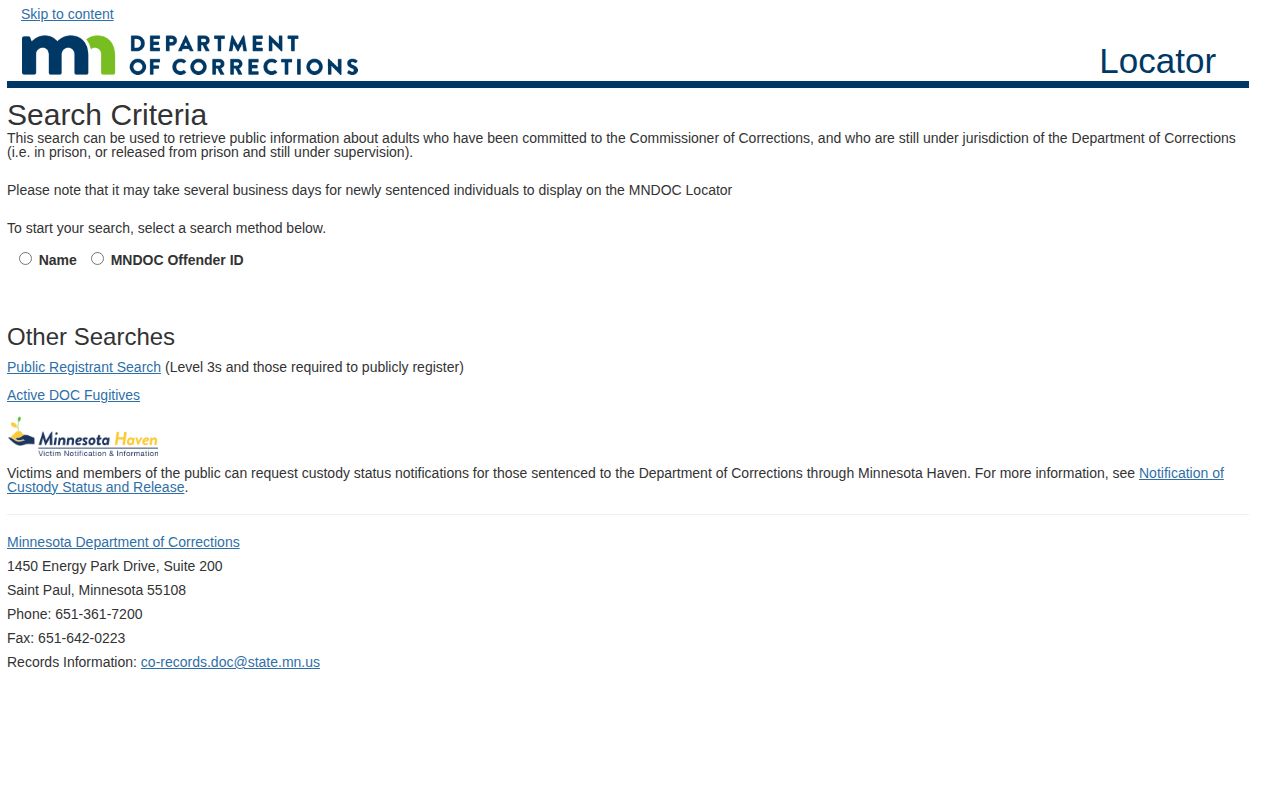
Search results should be matched to the court file and identity fields before any anticipated release date is attributed to a person.
The detail fields form a useful cross-check. Current status and facility describe the present DOC placement. Sentence date identifies the start of the displayed state-corrections episode. Anticipated Release Date addresses the expected move from prison under the current calculation, while expiration marks a later jurisdiction endpoint. The highest-ranked offense and court file number help connect the DOC result to the right Freeborn court case. A listed caseworker provides a direct route when the date has passed or the calculation needs clarification.
An under-supervision detail looks different. It may identify the release type, an “as of” date, a district or unit, the sentence date, expiration, and an agent-office link. Copy the release type rather than replacing it with parole. Supervised release, CIP Program Release, and other terms do not all mean the same thing. If the person no longer falls within the viewer’s jurisdictional scope, a historical record request to DOC may be needed.
Freeborn Release Sentence Structure
Minnesota is not a generic “serve 85 percent” state. For ordinary modern executed felony sentences, Minnesota Statutes section 244.01 and section 244.101 describe a two-thirds imprisonment part and a one-third supervised-release part. The court explains the total term, confinement, supervision, and the chance that discipline can extend confinement. This structure helps explain why prison exit can occur before the expiration date.
The old one-day-for-two-days “good time” rule in section 244.04 applies to crimes committed before August 1, 1993. It is not the rule for an ordinary modern offense. Older sentences, life terms, and other statutory classes require their own analysis. Copying a simple fraction onto every record would ignore jail credit, consecutive or concurrent terms, and offense-specific law.
Minnesota’s Rehabilitation and Reinvestment Act adds earned incentive release, or EIR, credit. Eligible participants can earn it through an individualized rehabilitation plan. Under section 244.44, EIR credit is capped at 17 percent of the executed sentence and may not reduce confinement below one-half of that sentence. Credit can be revoked for rule violations or criminal conduct. It does not shorten the total legal sentence or lengthen supervised release.
Earned compliance credit affects active supervision after prison. Supervision abatement can end routine active correctional supervision without moving the legal expiration date. That change must not be called final discharge. These rules are why the live DOC label is more useful than an unofficial date calculator.
Note: Record the DOC field label and access date because sentence calculations and current status can change independently.
Why Freeborn Release Dates Change
An anticipated date reflects the sentence information and release rules known to DOC at that time. It can move forward or backward. Some changes affect confinement, while others affect only the form of release or the authority that receives the person. The exact record should name the event.
| Factor | Possible effect | Best record to check |
|---|---|---|
| Disciplinary confinement | Can extend time in prison | Current DOC detail and caseworker |
| EIR award or revocation | Can alter an eligible participant’s expected prison exit | DOC calculation and records |
| Sentence correction | May change dates or sentence structure | Court order and DOC detail |
| Consecutive sentences | One term may follow another without community release | Court files, DOC record, Board minutes if applicable |
| Detainer or receiving agency | Can turn departure into a transfer rather than freedom | Sheriff transfer field and receiving custodian |
| Special program or Board action | May change release type, timing, or conditions | DOC status and approved Board minutes |
| Calendar rule | May shift the scheduled supervised-release day | DOC date and governing statute |
A Board grant can be “constructive parole” into a consecutive sentence. The person remains confined in that event. Likewise, “Under Supervision” confirms a prison exit but not the end of the sentence. These precise labels prevent a projected-date lookup from becoming a false statement of freedom.
Confirm Freeborn Release Dates
County and state notifications use different systems. Minnesota VINE covers Freeborn County and other county detention facilities, not DOC prisons. Register before a county event when possible. Its alert can report release, transfer, escape, or death, and the normal data feed may lag the legal event. The sheriff record remains the source for the exact date, time, and legal basis.
Minnesota DOC uses HAVEN for prison custody and release notification. The public viewer supplies current corrections status. If it changes to “Under Supervision” with an effective date, that is stronger proof of prison exit than the anticipated field. The Freeborn County VINELink Check explains county registration and the separate HAVEN route.
For county custody, ask Sheriff Records for release and transfer fields under section 13.82. Include the person’s full name, an approximate booking range, and a case or booking identifier when available. If the person went to DOC, ICE, another county, or another custodian, preserve “transfer” until that receiving system documents a later release.
Freeborn Sheriff Records publishes 507-377-5200, option 1, with weekday office hours from 8:00 a.m. to 4:30 p.m. A focused request should ask for the existing booking episode, the date, time, and legal basis for release, plus any transfer entry and receiving agency. Minnesota law does not require the county to build a new projection or custom list. It does make maintained release and transfer fields public unless another legal classification applies.
If the state detail is no longer online, DOC Records Management can be asked for an existing release date and type, supervision start, expiration, final-discharge record, or related decision. That request answers historical DOC questions, not the physical county-jail exit. Keep the Freeborn sheriff record, court file, and DOC episode distinct even when one event led to the next.
Freeborn Release Weekend Date Rule
Minnesota has a state-prison calendar rule that is easy to misapply. Under section 244.05, subdivision 1a, a modern scheduled supervised-release date that falls on Friday, Saturday, Sunday, or a holiday moves to the first following day that is not one of those days. Older offenses use a different preceding-day rule. The offense date and DOC calculation therefore matter.
This provision is not an automatic weekend policy for the Freeborn County jail. County release may follow sentence completion, bail, a court order, or another event under local processing. Freeborn’s release document says sentence-completers normally leave in the morning of their last day and normal post-first-appearance release occurs in the afternoon, but those windows are not promised dates for a specific person.
The Minnesota-specific combination is important: the modern two-thirds confinement and one-third supervision structure, possible EIR credit for eligible participants, and the weekend or holiday shift can all shape the displayed Anticipated Release Date. None confirms that the gate event took place.
Freeborn Release Date by Custody
A county jail sentence, state prison sentence, pretrial detention, and federal or immigration custody do not share one calculator. The Freeborn roster has no projected-date field. MCRO may show the sentence or a release order, but the court register is not the jail-door timestamp. DOC displays its own anticipated and expiration dates only for people within state corrections jurisdiction.
ICE custody is also locally relevant because the Freeborn facility houses an ICE contract population. Its public roster count excludes ICE detainees. The ICE locator may cover present custody or a release from ICE custody within the prior 60 days, but that result does not establish a Minnesota release or freedom from all custody. BOP results are limited to federal prison custody.
Use the system label in every note: Freeborn county jail, Minnesota DOC, ICE, or BOP. Then record whether the field is anticipated, actual release, transfer, under supervision, expiration, or discharge. This small discipline keeps the dates useful and prevents unlike events from being combined.
Note: A transfer date answers when one agency relinquished custody, not when the receiving agency later released the person.